
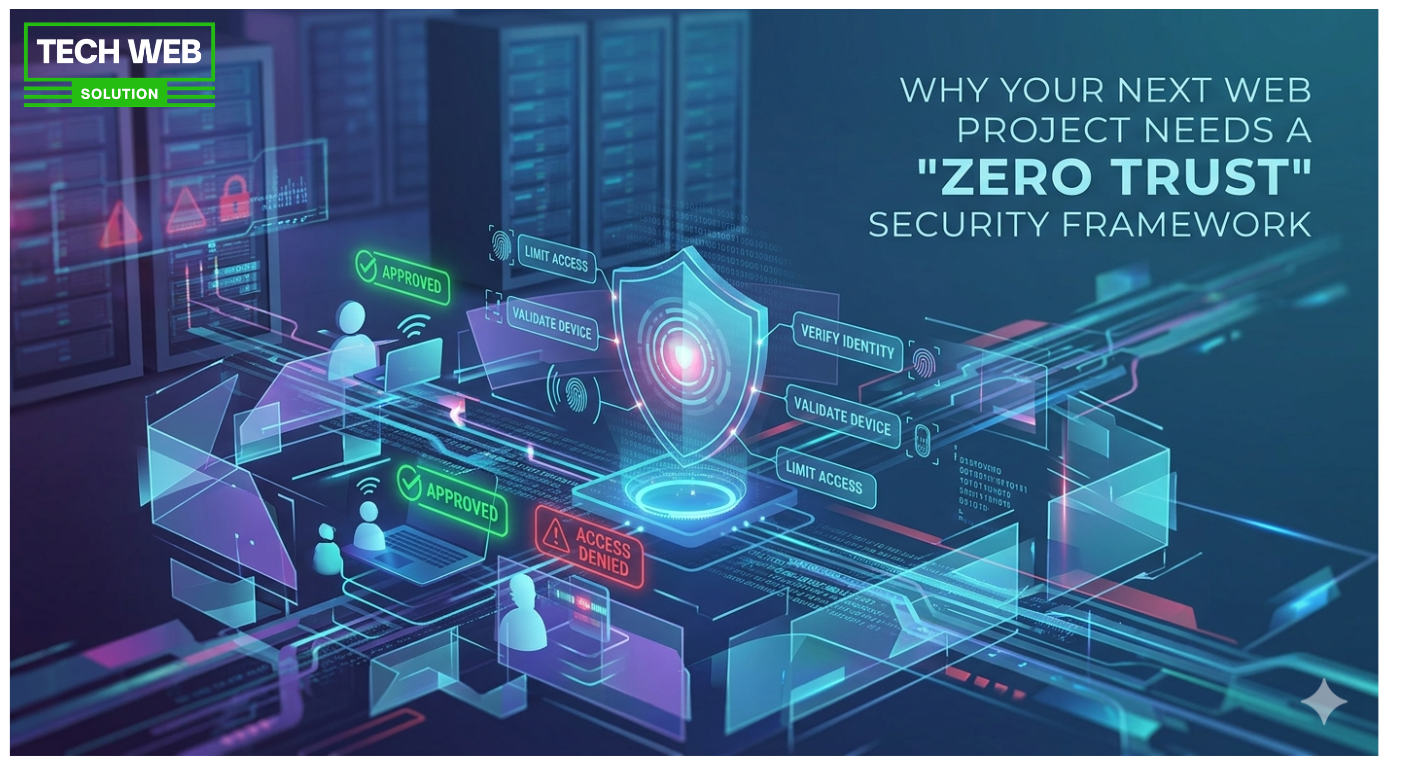
Why Your Next Web Project Needs a Zero Trust Security Framework in 2026
In today’s digital-first business environment, websites are no longer just online brochures—they are business assets, customer touchpoints, sales channels, and data hubs. Whether you’re launching an eCommerce store, a corporate portal, a SaaS platform, or a customer dashboard, security can no longer be treated as an afterthought.
Cybersecurity threats are evolving at an alarming pace. Recent industry reports show a 126% year-over-year increase in ransomware attacks, making businesses of all sizes prime targets. Attackers are no longer focusing only on large enterprises; small and mid-sized businesses are increasingly vulnerable because of weaker security structures.
At Tech Web Solution, we believe the future of secure web development starts with a modern security model: Zero Trust architecture (ZTA).
The old security model relied on a simple principle: trust everything inside the network and verify only outside threats. That model no longer works.
Today’s reality requires a stronger mindset:
Never trust. Always verify.
This is the foundation of Zero Trust.
In this article, we’ll explore why your next web project should adopt a Zero Trust framework, how it reduces ransomware risks, and how AI-powered threat detection is changing modern web security.
What Is Zero Trust Architecture (ZTA)?
Zero Trust Architecture is a cybersecurity model based on one simple assumption:
No user, device, application, or request should be trusted by default.
Every access attempt must be verified continuously.
Unlike traditional perimeter-based security, Zero Trust assumes that threats can exist both outside and inside the network.
This means:
- Every login attempt must be authenticated
- Every API request must be validated
- Every user session must be monitored
- Every device must be checked for security compliance
In web development, this transforms how applications are designed.
Instead of building applications that trust internal traffic, Zero Trust builds applications that verify every interaction.
Why Traditional Web Security Is Failing
Traditional security models often rely on:
- Firewalls
- VPNs
- Password-based authentication
- Limited endpoint monitoring
The problem?
Once an attacker gets inside, movement becomes easier.
A compromised admin panel, leaked credentials, vulnerable plugin, or outdated API can open the door to a ransomware attack.
This is especially dangerous for:
- WordPress websites
- eCommerce stores
- Customer portals
- Membership websites
- Web applications with sensitive data
Attackers exploit trust.
Zero Trust removes unnecessary trust.
That’s why businesses investing in secure web development are shifting toward Zero Trust architecture.
Understanding the 126% Rise in Ransomware Attacks
Ransomware is one of the fastest-growing cyber threats.
It works by:
- Gaining access to systems
- Encrypting files or databases
- Demanding payment for restoration
For web businesses, ransomware can affect:
- Customer databases
- Payment systems
- Website files
- Cloud backups
- CRM systems
The impact includes:
Financial Loss
Downtime means lost revenue.
For eCommerce businesses, even one day offline can cause major damage.
Reputation Damage
Customers lose trust in businesses that fail to protect data.
SEO Impact
If your website is hacked, Google may flag it as unsafe, reducing rankings and traffic.
Legal Compliance Issues
Data breaches can create compliance violations under privacy regulations.
The 126% increase in ransomware proves one thing:
Businesses need proactive security.
Not reactive security.
That’s where Zero Trust architecture (ZTA) becomes essential.
The Core Principle: Never Trust, Always Verify
Zero Trust changes how web applications think about access.
Instead of assuming a user is legitimate after login, verification happens continuously.
Here’s how:
Identity Verification
Every user must prove identity.
This includes:
- Multi-factor authentication (MFA)
- Biometrics
- Security tokens
Device Verification
Only approved devices gain access.
Compromised devices are blocked.
Access Control
Users only access what they need.
No unnecessary permissions.
Continuous Monitoring
Behavior is analyzed in real time.
Suspicious activity triggers alerts.
This “never trust, always verify” mindset dramatically reduces attack surfaces.
How Zero Trust Improves Secure Web Development
Secure web development is more than writing clean code.
It means building applications with security integrated into every stage.
Zero Trust strengthens development by improving:
1. User Authentication Security
Weak passwords remain a major vulnerability.
Zero Trust adds:
- MFA
- Single sign-on (SSO)
- Adaptive authentication
This makes account takeover much harder.
2. API Security
Modern websites rely heavily on APIs.
APIs are major attack targets.
Zero Trust ensures:
- API authentication
- Request validation
- Token expiration
- Rate limiting
This protects data exchange.
3. Database Protection
Databases store sensitive business information.
Zero Trust limits access by role.
For example:
A content editor doesn’t need database-level permissions.
Access segmentation reduces damage.
4. Admin Panel Security
Admin dashboards are prime targets.
Zero Trust secures admin panels through:
- IP restrictions
- Device verification
- Session monitoring
- Access logs
This minimizes unauthorized admin access.
5. Cloud Security
Many web applications use cloud hosting.
Amazon Web Services, Google Cloud, and Microsoft Azure environments benefit from Zero Trust by verifying every cloud interaction.
Cloud trust should never be automatic.
The Role of AI-Powered Threat Detection
Cyber threats are moving faster than manual systems can detect.
That’s why AI-powered threat detection is becoming critical.
Artificial Intelligence helps identify unusual activity in real time.
Examples include:
- Login pattern anomalies
- Bot traffic detection
- Malware behavior analysis
- Credential stuffing attacks
- Suspicious file uploads
AI detects threats before damage happens.
How AI and Zero Trust Work Together
Zero Trust defines the rules.
AI monitors behavior.
Together they create stronger web security.
For example:
A user logs in from India.
Minutes later, another login appears from another country.
AI detects impossible travel behavior.
Zero Trust blocks access until verification.
This reduces fraud and ransomware risk.
Benefits of Zero Trust for Business Websites
Implementing Zero Trust architecture (ZTA) offers major business benefits.
Better Data Protection
Customer data remains protected through strict verification.
Reduced Ransomware Risk
Attackers cannot move freely inside systems.
Improved Customer Trust
Customers trust secure platforms.
Trust improves conversions.
Better SEO Stability
A secure website avoids malware warnings and search penalties.
Security supports SEO performance.
Stronger Compliance
Zero Trust helps support privacy and security requirements.
Scalability
As your business grows, Zero Trust scales with your infrastructure.
Zero Trust for WordPress Websites
WordPress powers a huge percentage of websites.
It is powerful—but frequently targeted.
Zero Trust improves WordPress security through:
Plugin Validation
Only verified plugins should be installed.
Admin Access Controls
Limit admin users.
Verify access.
File Integrity Monitoring
Detect file changes instantly.
Login Security
Protect against brute-force attacks.
Backup Verification
Backups should be secure and isolated.
WordPress websites especially benefit from Zero Trust architecture.
Zero Trust for eCommerce Platforms
WooCommerce, Shopify, and Magento manage sensitive payment and customer data.
Security is critical.
Zero Trust helps by:
- Protecting checkout APIs
- Monitoring transactions
- Verifying admin actions
- Restricting inventory access
This reduces fraud and ransomware exposure.
Key Components of a Zero Trust Web Project
If you’re planning your next web project, include:
Identity and Access Management (IAM)
Control who gets access.
Verify every user.
Multi-Factor Authentication
Add another security layer.
Endpoint Security
Protect devices connecting to systems.
Micro-Segmentation
Break systems into smaller protected areas.
Attackers cannot move freely.
Encryption Everywhere
Protect data in transit and at rest.
Logging and Monitoring
Track every activity.
Visibility is essential.
AI-Powered Threat Detection
Use AI for faster response.
Modern attacks require modern defense.
Common Mistakes Businesses Make
Many businesses delay security planning.
Big mistake.
Common issues include:
Security After Launch
Security should start during development.
Not after deployment.
Overtrusting Internal Users
Insider threats are real.
Verification matters.
Weak Plugin Management
Outdated plugins create vulnerabilities.
Poor Backup Strategy
Backups should be secure and tested.
Ignoring Threat Intelligence
AI-powered monitoring improves visibility.
How Tech Web Solution Implements Zero Trust
At Tech Web Solution, we build websites with security-first thinking.
Our Zero Trust web development process includes:
Secure Authentication Systems
MFA and access verification.
Secure Code Practices
Clean, validated code.
API Security Controls
Protected API communication.
AI-Powered Threat Detection Integration
Real-time threat analysis.
Role-Based Access
Minimal permissions.
Continuous Monitoring
Ongoing visibility.
Security Testing
Before launch and after launch.
We believe secure web development should be part of every project.
Not an optional add-on.
The Future of Web Security
Cybersecurity is shifting fast.
Future trends include:
AI-Driven Security Automation
Threats detected and blocked faster.
Behavioral Authentication
User behavior becomes part of security.
Passwordless Access
Safer authentication models.
Smarter Cloud Security
Cloud-native Zero Trust models.
Automated Threat Intelligence
Faster threat updates.
Businesses that adapt early will be stronger.
Why Zero Trust Is an SEO Advantage
Many businesses ignore the SEO impact of security.
Search engines care about user safety.
A hacked website can lead to:
- Blacklisting
- Ranking drops
- Traffic loss
- User distrust
A secure website improves:
- Site reliability
- User confidence
- Technical SEO health
Security is now part of digital visibility.
Zero Trust supports long-term SEO performance.
Questions to Ask Before Starting Your Next Web Project
Before hiring a web development team, ask:
- How do you secure user authentication?
- How do you protect APIs?
- Do you use Zero Trust architecture (ZTA)?
- Do you provide AI-powered threat detection?
- How do you prevent ransomware risks?
- What monitoring systems are included?
If these questions cannot be answered clearly, security may not be a priority.
Final Thoughts
Cyber threats are increasing.
Ransomware is growing.
Web security is changing.
The 126% rise in ransomware attacks is not just a statistic—it’s a warning.
Traditional security models are no longer enough.
Businesses need stronger frameworks.
Zero Trust architecture (ZTA) offers exactly that.
By adopting the never trust, always verify approach, businesses can build stronger, safer, and smarter web applications.
Combined with secure web development practices and AI-powered threat detection, Zero Trust creates a future-ready security strategy.
Your next website should not just look good.
It should be built to survive modern cyber threats.
At Tech Web Solution, we help businesses build secure, scalable, and high-performing web solutions designed for today’s digital risks.
Because in modern web development:
Trust is no longer a security strategy. Verification is.
Ready to Build a Secure Website?
If you’re planning your next website, eCommerce store, or web application, make security your first decision—not your last.
Partner with Tech Web Solution to implement Zero Trust architecture (ZTA), strengthen secure web development, and integrate AI-powered threat detection into your digital foundation.
Your business deserves security built for the future.